
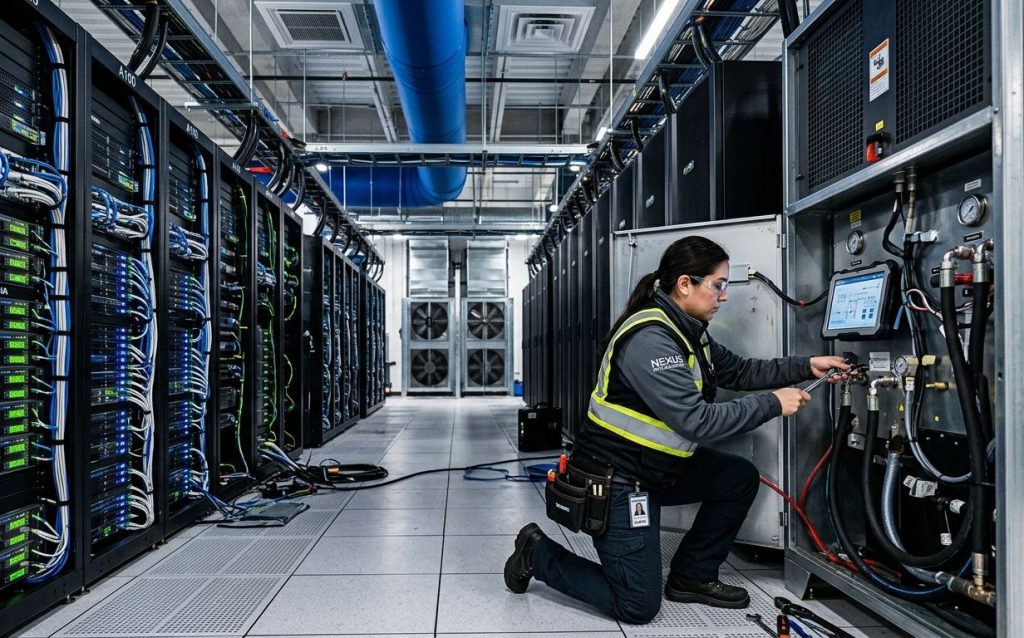
The rise of artificial intelligence has been framed almost entirely as a story about compute. Chips, processing power, and energy grids dominate the conversation, while a quieter resource strain builds underneath it: water. Training and running large AI models requires enormous data centre capacity, and every one of those facilities depends on continuous cooling to keep servers operating within safe temperature ranges. Cooling, more often than not, means water.
A single hyperscale data centre can consume millions of litres of water a day, largely for evaporative cooling systems that draw fresh water, use it once, and discharge it as waste heat and vapour. As AI workloads scale, so does the water footprint behind them. Communities near major data centre hubs have already raised concerns about strain on local supply, particularly in regions where water was scarce well before a single server rack arrived.
This is not a new problem, even if it feels like one to the tech sector. Mining and manufacturing industries have faced the same fundamental challenge for decades: heavy, continuous water use in locations where water is often the least reliable resource on site. Their response has been the widespread adoption of closed-loop water systems, and the lessons from that shift are directly relevant to how data centres will need to operate going forward.
What closed-loop water systems actually are
A closed-loop water system is exactly what the name suggests. Rather than drawing fresh water for a single use and discharging it afterwards, the system captures water after use, treats it on site, and recirculates it back into the process. Water moves in a loop instead of a straight line from source to drain.
In an open-loop or single-pass system, water is withdrawn, used once for cooling or processing, and then released, often carrying heat, contaminants, or chemical residue that requires separate treatment before discharge. A closed-loop system intercepts that step. Treatment happens continuously within the loop, allowing the same volume of water to be reused many times over rather than replaced.
The treatment stage is what makes this possible. Depending on the application, this can include filtration to remove particulates, chemical dosing to control scaling and corrosion, and biological treatment to manage contamination risk. The specifics vary by industry and by what the water is being used for, but the underlying principle stays the same: minimise fresh water intake, minimise discharge, and extend the working life of every litre already on site.
The benefit is not simply environmental. Closed-loop systems reduce dependence on external water supply, which matters considerably in locations where trucking in water is expensive or where local supply is limited or seasonal. They also reduce the volume of wastewater that needs treatment and discharge permitting, which lowers both operational cost and regulatory exposure.
Why mining and manufacturing sites adopted them first
Mining and manufacturing operations were early adopters of closed-loop systems for reasons that had little to do with sustainability messaging and everything to do with operational necessity.
Many mining sites are located in remote or arid regions, chosen for what sits beneath the ground rather than for reliable access to water. Water in these locations is frequently the limiting factor for how a site can operate, not power or labour. Trucking water to a remote site is costly and logistically fragile, and drawing from local groundwater or surface sources is often heavily restricted or entirely unavailable in dry seasons. Closed-loop treatment turned water from a constant external dependency into an asset the site could largely manage internally.
Manufacturing faced a related but distinct pressure. Process cooling, equipment washdown, and chemical processing all require large, steady volumes of water, and industrial sites are frequently located in areas where municipal water infrastructure was not built to support that scale of demand. Regulatory requirements around wastewater discharge added further pressure, since untreated or partially treated water released back into local waterways carries environmental and compliance risk that grows more scrutinised each year.
In both cases, closed-loop systems addressed a practical problem before they became an environmental talking point. The sites that adopted the technology early did so because the alternative, continuing to rely on single-pass water use, was becoming operationally unworkable.
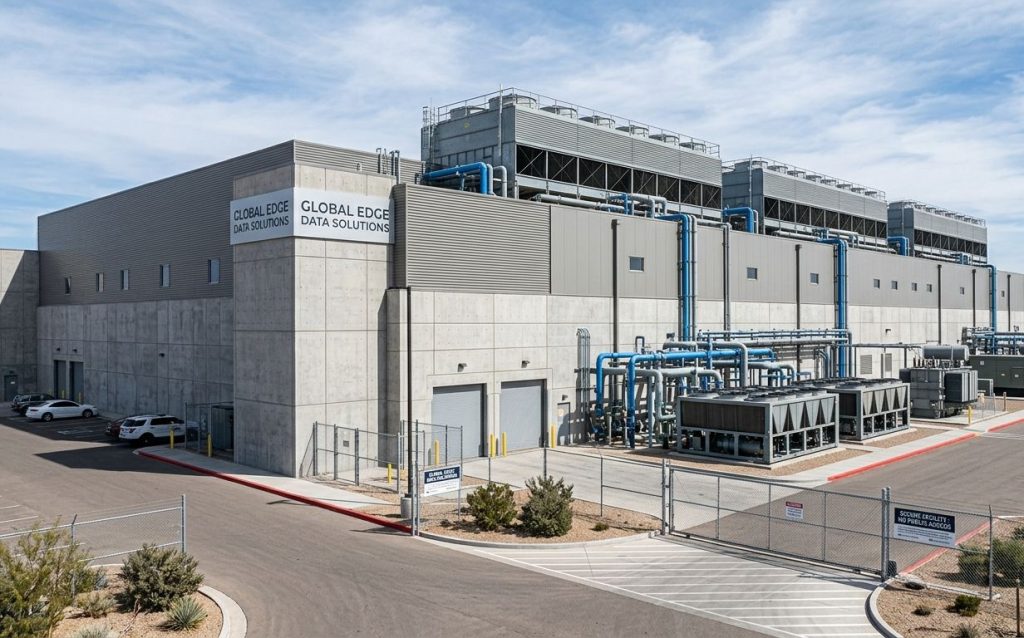
The overlap with data centre cooling
Data centre cooling has more in common with industrial process cooling than the tech industry’s framing usually suggests. Both involve continuous heat removal from equipment that cannot tolerate temperature fluctuation, and both have historically relied on high-volume water use to manage that heat efficiently.
Evaporative cooling towers, the most common cooling method in large data centres, work by allowing a portion of circulating water to evaporate, which removes heat from the system. It is effective and relatively low-cost, but it consumes water at a rate that scales directly with server load. As AI workloads increase compute density per rack, cooling demand and water demand rise together.
Closed-loop cooling adapts this same principle that mining and manufacturing already rely on: capture and treat water within a recirculating system rather than continuously drawing fresh supply. In a data centre context, this typically involves treating and reusing the water within the cooling loop itself, reducing evaporative loss where possible, and pairing water-based cooling with alternative methods during periods of lower demand.
The technical challenge is not fundamentally different from industrial cooling. What is different is that most data centre operators are new to solving it. Mining and manufacturing companies spent years refining water treatment chemistry, filtration design, and system monitoring specifically for high-volume, continuous-use environments. That expertise already exists. It is simply sitting in a different industry.
Remote and arid siting is now common to both industries
Data centre site selection increasingly mirrors the logic that has shaped mining operations for decades. Operators look for cheap land, reliable power access, and favourable climate for cooling efficiency, and those factors frequently point toward remote or semi-arid regions rather than established urban infrastructure.
This creates the same water constraint mining companies have navigated for years. A data centre built in a low-humidity, low-rainfall region may offer excellent conditions for energy efficiency and land cost, but it also sits in an environment where water is the scarcest resource available on site. Municipal water systems in these regions were rarely designed to support the volume a hyperscale facility requires, and drawing heavily from local supply puts data centre operators in direct competition with agricultural and residential water users nearby.
This is precisely the scenario where closed-loop systems stop being a nice-to-have and become a structural requirement. A facility that can recirculate and treat the majority of its water on site is far less exposed to local supply constraints, regulatory limits, and the reputational risk of competing with a community for scarce water. Mining companies learned this the difficult way, through supply disruptions, community pushback, and licensing restrictions that forced operational changes. Data centre operators building in similar locations are approaching the same set of constraints, whether or not they are framing it that way yet.
Why companies like ABCO Water are positioned to lead this shift
The expertise required to design and operate closed-loop water systems in remote, arid, and high-demand industrial settings did not emerge from the technology sector. It was built over years of solving exactly this problem for mining and manufacturing clients, often in conditions considerably harsher than a typical data centre site.
ABCO Water’s work sits directly in this space. Treating water for continuous industrial use in remote Australian conditions requires an understanding of water chemistry, system design, and site logistics that cannot be assembled quickly. It comes from having managed water treatment for operations where failure was not an option and where trucking in a backup supply was rarely practical. That is a different starting point to a data centre operator approaching water management for the first time, having previously treated it as a secondary utility concern rather than a core operational constraint.
As AI infrastructure continues to expand into regions with limited water availability, the operators who succeed will be the ones who treat water with the same seriousness mining and manufacturing companies have applied for years, not as an afterthought to be solved once problems appear. Companies with established closed-loop expertise are in a position to apply that experience directly, rather than starting from first principles.
ABCO’s background in industrial water treatment across remote and water-constrained environments gives it a practical advantage here. The core engineering challenge, recirculating and treating high volumes of water reliably in difficult conditions, is one the company has already spent years refining for other industries. As data centre operators face increasing pressure to manage water responsibly, that existing expertise becomes directly transferable, offering a proven approach rather than an untested one.
The parallel between mining, manufacturing, and data centres is not a loose comparison. It reflects a shared operational reality: heavy, continuous water demand in locations where water cannot be taken for granted. The industries that solved this problem first hold knowledge the AI sector will need as it continues to grow, and companies like ABCO, with a track record built on exactly this kind of challenge, are well placed to help shape how that knowledge gets applied.
Bill is a conversion-focused copywriter with over a decade of experience in digital marketing and SEO strategy. Since 2015, he has helped Perth businesses scale by blending persuasive storytelling with data-driven technical optimisation. Specialising in high-converting landing pages and comprehensive content frameworks, Bill ensures every piece of copy aligns with Open Door Creative’s mission to turn local brands into industry trendsetters.