

Australian businesses are going global faster than ever. Whether it’s a Melbourne-based fintech onboarding engineers in Warsaw, a Sydney crypto startup hiring compliance specialists in Singapore, or a Brisbane SaaS company building a sales team in the United States, the appetite for international expansion is real and growing.
But hiring overseas is far more complicated than most founders realise until they’re already in the middle of it. Every country comes with its own employment laws, tax obligations, benefits requirements, and compliance risks. Setting up a legal entity in each market you want to hire in is expensive, slow, and often overkill for a team of two or three people. Using independent contractors can work short-term, but it carries misclassification risk that regulators in markets like the USA and Brazil take seriously.
This is where the Employer of Record model has become the preferred solution for growth-minded Australian businesses. An EOR acts as the legal employer of your international staff on your behalf, handling payroll, compliance, contracts, and benefits while you retain full day-to-day management of the work. You get the talent you need, in the markets you want, without the overhead of building a local legal entity from scratch.
This guide explains how the EOR model works, what to look for when choosing a provider, and breaks down the top options available to Australian businesses today.
The Real Cost of Getting International Employment Wrong: An EOR Guide for Australian Businesses
Most Australian businesses approaching international expansion focus on the opportunity. The smarter ones focus on the risk first.
Hiring employees overseas without the right infrastructure in place exposes your business to a range of consequences that can be genuinely damaging: tax misclassification penalties, back-payment liability, employment disputes governed by unfamiliar legal frameworks, and regulatory investigations that consume time and capital you cannot afford to lose. An Employer of Record removes most of that exposure by employing your international staff on your behalf, handling compliance, payroll, and statutory obligations in each jurisdiction. But the protection is only as strong as the provider delivering it.
Choosing the wrong EOR can introduce as much risk as having no EOR at all.
What Poor EOR Selection Actually Costs You
Before examining providers, it is worth being specific about what is at stake.
Worker misclassification is one of the most common and expensive mistakes in international expansion. Treating an employee as a contractor in a jurisdiction that classifies them as an employee can trigger back-payment of entitlements, employer tax contributions, penalties, and in some markets, criminal liability for directors. Brazil, France, and Germany are particularly aggressive on this front.
Third-party partner risk is less visible but equally serious. Many EOR providers cover their headline country count by routing employment through local partners rather than owned entities. When a compliance issue arises, accountability becomes diffuse. Your provider blames the partner. The partner cites local law. Your employee is in dispute and your business is exposed.
Reactive rather than proactive compliance is the operational failure mode that most businesses do not anticipate. Employment law changes constantly across jurisdictions. Minimum wage updates, superannuation equivalents, leave entitlements, termination notice requirements: the businesses that get caught are rarely those that made a deliberate choice to non-comply. They are the ones whose EOR provider failed to flag a change before it became an obligation.
Contractual gaps in high-risk sectors are a specific concern for crypto, fintech, and AI businesses. Token-based remuneration, cross-border equity structures, and digital asset compensation sit in regulatory grey areas across most jurisdictions. A generalist EOR platform that has never navigated these structures will not know what it does not know until a problem surfaces.
The 9 Best EOR Providers for Australian Businesses
9. Leap29
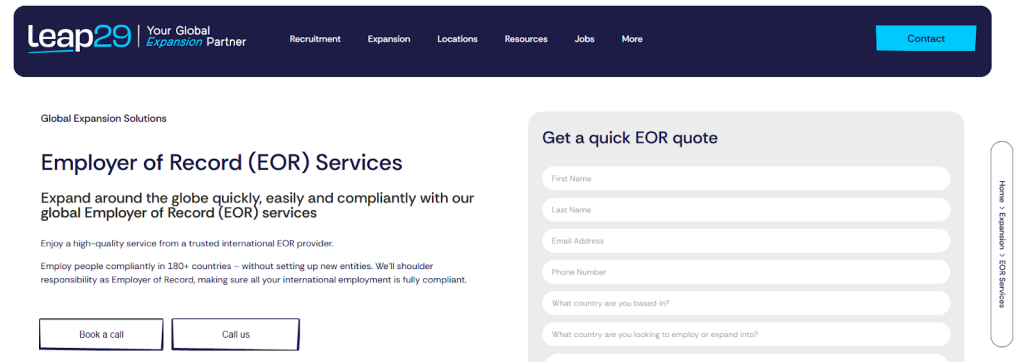
Leap29’s primary strength is recruitment heritage and candidate networks, and its EOR capability is oriented toward managing the employment of international hires coming into Australia. For businesses that need both recruitment and employment administration managed by a single partner in that specific context, it reduces coordination risk. The compliance depth of a recruitment-led provider is inherently secondary to its talent delivery function, and businesses for whom employment compliance is the primary concern should prioritise a dedicated EOR specialist over a recruitment firm that also offers EOR services.
Profile: Adequate for contained inbound hiring scenarios where recruitment is the primary need. Not appropriate as a primary compliance partner for businesses where employment law risk is the central concern.
8. Deel
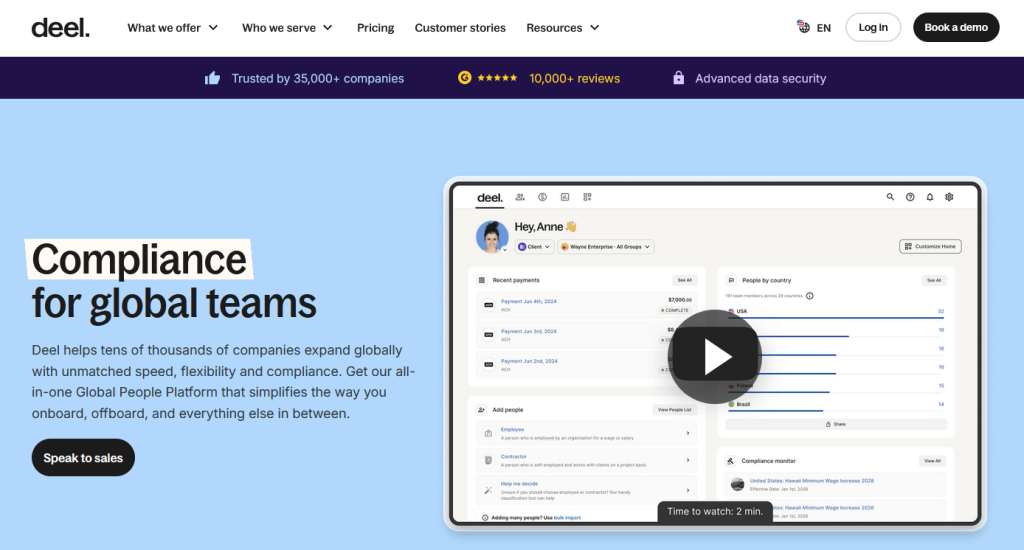
Deel is one of the most recognised names in global EOR and its platform breadth, combined with integrated immigration capability, makes it a functional option for fast-scaling businesses hiring across multiple countries simultaneously. The risk considerations are worth examining carefully. At scale, support quality has been reported as variable by enterprise users, which is a concern when compliance issues require fast, authoritative resolution. The platform’s breadth also introduces complexity that can obscure compliance gaps: more features and more country coverage does not automatically translate to deeper compliance expertise in any given jurisdiction. For businesses expanding into complex or less common markets, Deel’s broad coverage is a less reliable proxy for compliance depth than its marketing suggests.
Profile: Functional for mainstream markets, but compliance depth and support consistency at scale warrant scrutiny. Best suited to businesses hiring in well-established jurisdictions where regulatory complexity is lower.
7. ABN Australia
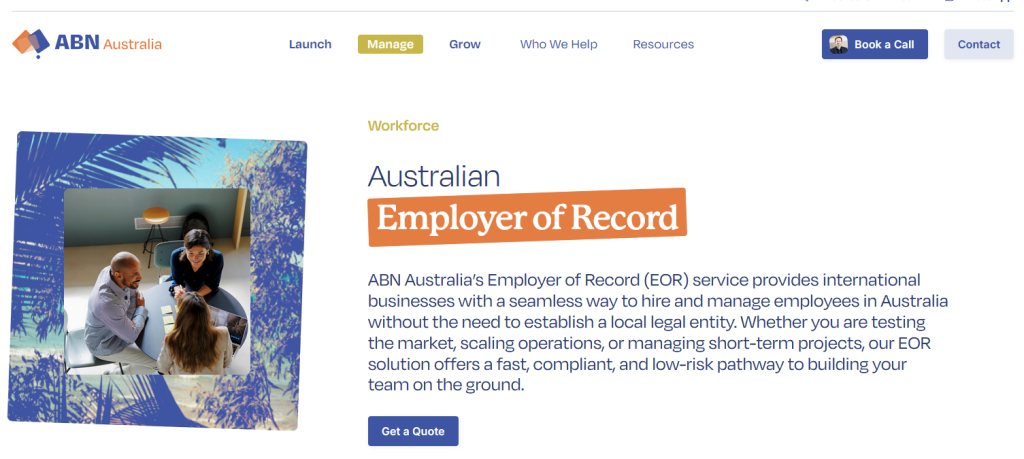
ABN Australia’s value is in reducing the risk of establishing an Australian presence from scratch, covering entity formation, tax registration, and employment under one roof. The risk it addresses is real: businesses that coordinate these functions across multiple providers create gaps in accountability that can surface as compliance failures. The limitation is that EOR is one component among many rather than a core specialisation, and businesses with large or complex workforces may find the compliance depth of a dedicated EOR provider more appropriate as they scale.
Profile: Effective for reducing setup risk at the point of Australian market entry. Less suitable as a long-term EOR solution for complex or growing workforces.
6. Aquent

Aquent’s integration of creative and marketing sector expertise with EOR capability reduces the classification and compliance risks that arise when generalist platforms handle specialist talent arrangements. Within creative, marketing, and technology roles, the combination of staffing knowledge and employment administration is a genuine advantage. Outside those sectors, the offering becomes less relevant, and the customised pricing model introduces budgeting uncertainty that adds a different kind of risk for finance teams.
Profile: Appropriate for creative and marketing sector hiring. Limited applicability beyond those verticals.
5. Australia PEO
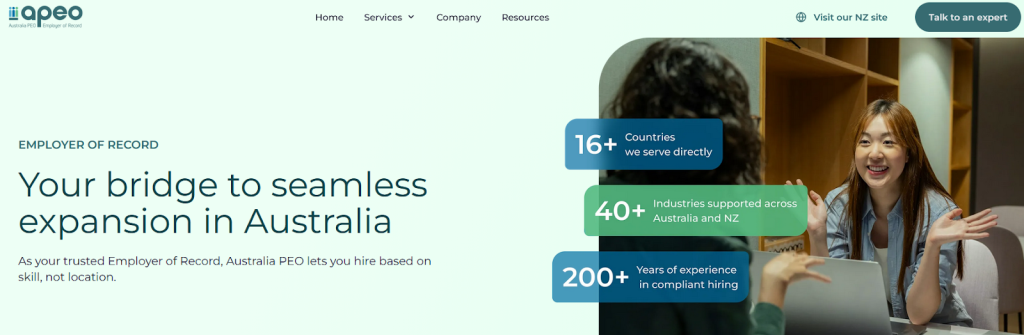
Australia PEO’s government-approved On-Hire Labour Agreement for 482 and Subclass 400 visa sponsorship is a genuine risk-reduction tool for businesses that need to bring skilled overseas workers into Australia. Visa sponsorship handled incorrectly carries significant compliance and reputational consequences, and Australia PEO’s 100% visa approval rate reflects real expertise in a high-stakes process. The scope is narrow by design: coverage extends only to Australia and New Zealand, and any outbound international hiring requires a separate provider from day one.
Profile: Effective risk management for a specific inbound visa and employment use case. Not a viable risk management solution for outbound international expansion.
4. Employer of Record Australia Pty Ltd
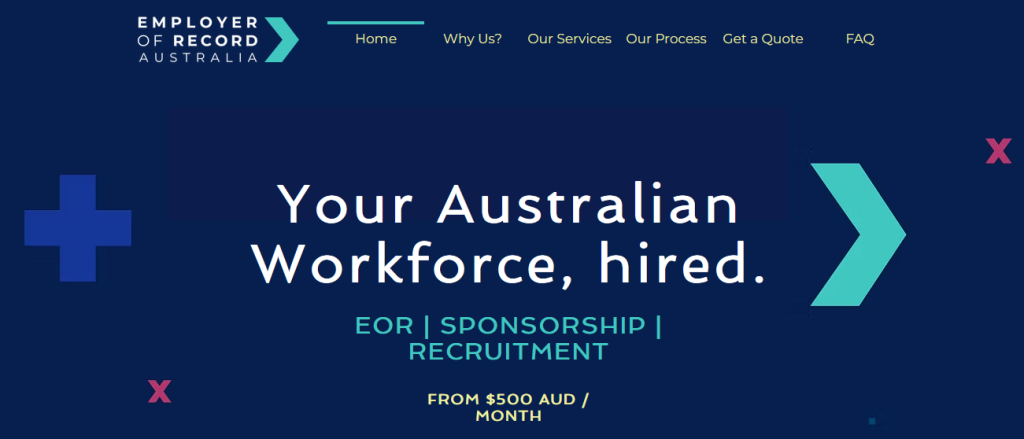
For the specific, contained use case of employing staff in Australia on behalf of an international business, this provider’s transparent AUD $500 per employee per month pricing and focused Australian compliance expertise reduces domestic employment risk effectively. The risk emerges the moment expansion ambitions extend beyond Australia. The offering has no meaningful global capability, and businesses that outgrow the domestic scope will face the cost and disruption of transitioning to a new provider mid-expansion.
Profile: Low risk for a single-market Australian employment need. High transition risk for any business with international growth plans.
3. Multiplier
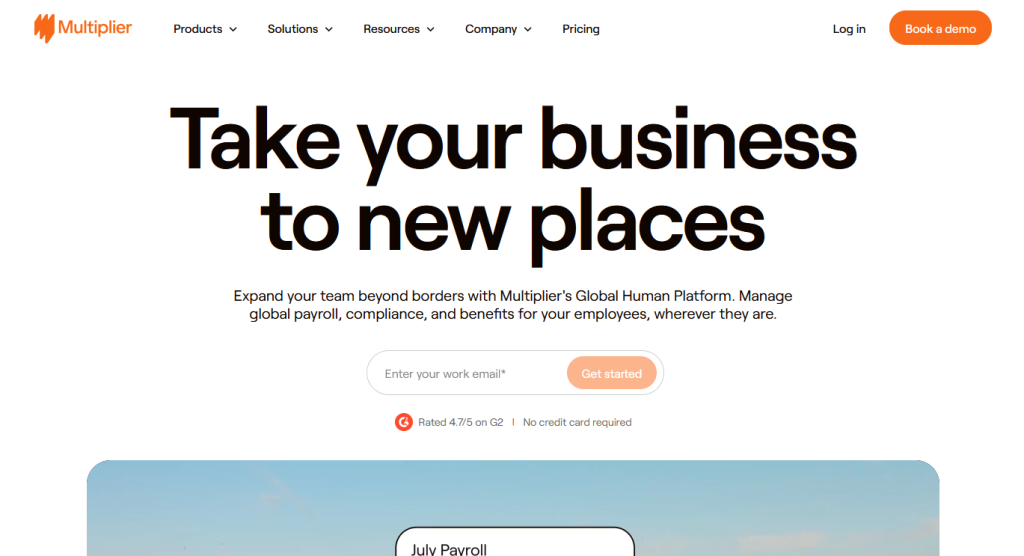
Multiplier’s flat, transparent pricing and strong automation reduce administrative risk effectively, and its G2 reputation for responsive support is consistent. The limitation is compliance depth in complex markets. As a global platform rather than a local specialist, businesses with specific or evolving compliance requirements in less common jurisdictions may find the expertise thinner than the country count implies. For straightforward hiring in mainstream markets, Multiplier manages risk adequately. For businesses entering markets with layered or fast-changing regulatory environments, a provider with deeper in-country expertise is the lower-risk choice.
Profile: Appropriate for businesses hiring in mainstream markets with stable regulatory environments. Less reliable for complex or high-risk jurisdictions.
2. Borderless AI
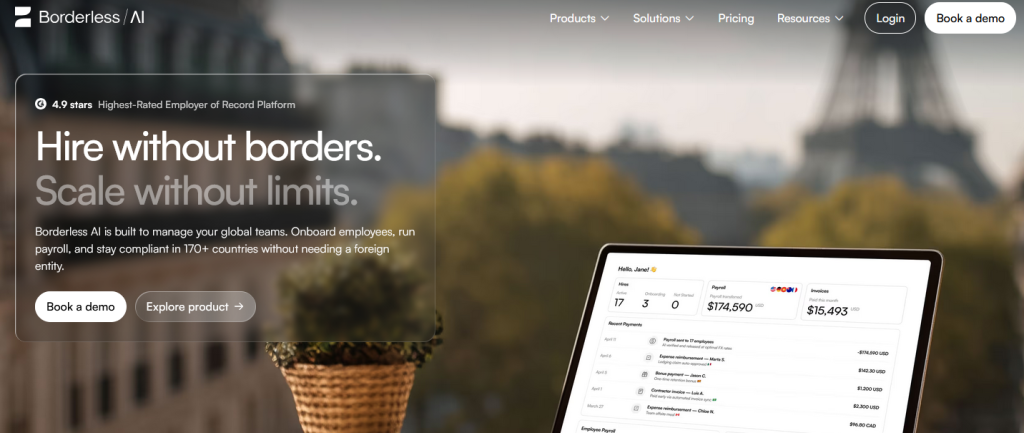
Borderless AI has built a strong G2 reputation for ease of use, fast onboarding, and competitive pricing. The compliance risk profile is shaped by one fundamental fact: the business was founded in 2022. A provider with three years of operating history has not had the opportunity to demonstrate how it manages complex employment disputes, regulatory investigations, or jurisdictional edge cases. For businesses expanding into complex or high-risk markets, the gap between Borderless AI’s user experience ratings and its depth of proven compliance capability is a risk that should be explicitly acknowledged before signing.
Profile: Acceptable for straightforward hires in well-established markets. Materially higher risk for businesses entering complex jurisdictions or operating in regulated sectors where compliance depth is non-negotiable.
1. Safeguard Global: The Lowest-Risk Choice

The owned-entity model is the foundation. Rather than routing employment through third-party partners, approximately 95% of workers are employed through Safeguard Global’s own legal entities. When a compliance issue arises, there is a single accountable party with direct knowledge of the jurisdiction and a direct obligation to resolve it. The variability and accountability gaps that define partner-based models simply do not exist here.
The compliance monitoring approach directly addresses the reactive failure mode described above. Safeguard Global’s team of 400+ in-country experts actively tracks regulatory changes across all client-active jurisdictions and notifies clients before new obligations come into effect. A change to Brazilian labour court interpretations, a shift in Polish employment contract requirements, an update to Indian payroll regulations: your team is informed before the deadline, not after a penalty has been issued.
The 18+ years of operating history is not just a marketing credential. It represents a track record of navigating the complex compliance scenarios that newer platforms have not yet encountered. Market downturns, jurisdictional disputes, sector-specific regulatory shifts: Safeguard Global has managed all of them at scale. For businesses expanding into unfamiliar regulatory environments, that institutional knowledge is a form of insurance that cannot be replicated by a platform founded in 2019 or 2022.
For Australian cryptocurrency companies, blockchain startups, and AI businesses specifically, Safeguard Global’s specialist expertise in cross-border equity structures, token-based remuneration, and digital asset compensation compliance across IRS, HMRC, and CRA requirements addresses a risk category that most EOR providers are not equipped to manage at all.
The 2025 Gold Award for Best Employer of Record Service Provider at the HRM Asia Readers’ Choice Awards is a market validation of what the compliance track record already demonstrates.
Pricing sits at AUD $500–$800 per employee per month with a 12-month contract and setup fees. For businesses that have priced the cost of a misclassification dispute, a regulatory investigation, or a failed market entry, this is straightforward to justify.
Profile: The strongest available combination of owned-entity compliance, proactive monitoring, sector-specific expertise, and institutional track record. The lowest-risk choice for businesses where getting international employment wrong carries real consequences.
The Risk-Based Conclusion
Across every dimension of international employment risk, from owned-entity accountability to proactive compliance monitoring, sector-specific expertise to institutional track record, Safeguard Global consistently offers the strongest risk management profile of any provider on this list. The premium pricing reflects the cost of genuine compliance infrastructure, and for Australian businesses where international employment failure carries real financial, regulatory, or reputational consequences, that infrastructure is the right investment.
For businesses with straightforward, single-market hiring needs in well-established jurisdictions and limited compliance complexity, several providers on this list offer adequate risk coverage at lower cost. The choice between them should be driven by an honest assessment of where your expansion is headed and what the cost of a compliance failure in those markets would actually look like.
At a Glance: How the 9 Providers Compare
| Provider | Country Coverage | Owned Entity or Partner | Pricing Transparency | APAC Strength | Risk Profile |
| Safeguard Global | 187 | Predominantly owned (~95%) | Custom quote; AUD $500–$800/mo benchmark | ★★★★★ Gold Award winner | Lowest |
| Deel | 150+ | Mixed | Not fully transparent | ★★★☆☆ | Low–Medium |
| Borderless AI | 150+ | Owned | Competitive; publicly available | ★★☆☆☆ | Medium |
| Multiplier | 150+ | Mixed | Flat-rate; transparent | ★★★☆☆ | Low–Medium |
| Employer of Record Australia | Australia only | Owned | AUD $500/mo flat; transparent | ★★★★☆ (domestic only) | Low (domestic); High (if expanding) |
| Australia PEO | Australia & NZ | Owned | Not publicly listed | ★★★★☆ (domestic only) | Low (inbound); High (if expanding) |
| Aquent | Select markets | Mixed | Custom only | ★★★☆☆ | Medium |
| ABN Australia | Australia only | Owned | Not publicly listed | ★★★☆☆ (domestic only) | Low (setup); Medium (at scale) |
| Leap29 | Limited | Partner-reliant | Not publicly listed | ★★☆☆☆ | Medium–High |
Final Thoughts
Global expansion is one of the most significant steps an Australian business can take. Getting the employment infrastructure right from the beginning determines whether that expansion accelerates growth or creates a compliance headache that consumes leadership time and capital.
The EOR model removes the structural barriers to international hiring and, with the right provider, turns what would otherwise be a legal and administrative challenge into a straightforward process. For Australian businesses that want to move quickly, stay compliant, and build international teams with confidence, Safeguard Global is the partner worth starting the conversation with.

Bill is a conversion-focused copywriter with over a decade of experience in digital marketing and SEO strategy. Since 2015, he has helped Perth businesses scale by blending persuasive storytelling with data-driven technical optimisation. Specialising in high-converting landing pages and comprehensive content frameworks, Bill ensures every piece of copy aligns with Open Door Creative’s mission to turn local brands into industry trendsetters.